
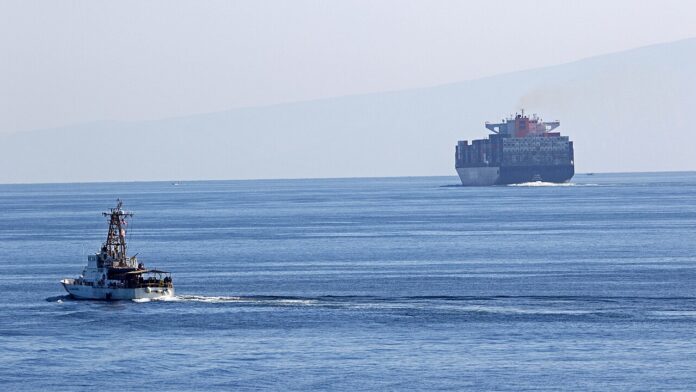
Two American warships have passed through the Strait of Hormuz as part of an operation aimed at preparing the conditions for clearing mines in one of the world’s most sensitive maritime corridors, according to the US Central Command, while at the same time American and Iranian delegations have begun crucial talks in Islamabad.
Centcom said that the USS Frank E. Peterson and USS Michael Murphy, both guided-missile destroyers, transited the strait and operated in the Arabian Gulf to begin what it described as “setting the conditions” for a mine-clearing mission. The move comes at a highly sensitive moment, as the United States seeks to restore freedom of navigation in a waterway vital for global energy trade.
However, it remains unclear whether Tehran has agreed to allow this operation. This uncertainty is critical, as the talks in Pakistan are focused precisely on issues related to the ceasefire, control over Hormuz, Iran’s nuclear programme and its frozen assets abroad. So far, there has been no independent confirmation that Iran has given explicit approval for US actions on the ground.
The Strait of Hormuz remains the central flashpoint of the crisis. It connects the Gulf to global markets, and any disruption there has immediate effects on oil prices, supply chains and energy costs worldwide. For this reason, any military movement in the area carries not only strategic but also economic weight.
Against this backdrop, the most significant direct talks between Washington and Tehran in decades have begun in Islamabad. The American delegation is led by Vice President JD Vance, while the Iranian side is headed by parliamentary speaker Mohammad Bagher Qalibaf. The meetings are aimed at extending a two-week ceasefire and preventing a renewed escalation after weeks of conflict that have shaken the region and global markets.
Yet optimism remains limited. Reports indicate that the US delegation entered the talks with low expectations, while officials in Washington have expressed doubts that the negotiations will quickly lead to a full reopening of the Strait of Hormuz. This suggests that, despite both diplomatic and military activity, the gap between the two sides remains substantial.
One of the most difficult points remains Iran’s list of conditions. Tehran has said that any meaningful process must include the issue of Lebanon, the release of frozen assets and recognition of its role in Hormuz. Meanwhile, Washington has denied that it agreed to release Iranian assets in advance and continues to insist on maritime security, limits on Iran’s nuclear capabilities and curbing its regional activities.
The issue of Lebanon has also added further tension. JD Vance has previously stated that the ceasefire announced between the US and Iran does not include Lebanon, despite differing interpretations from Iran and Pakistani mediators. This discrepancy is significant, as it shows that the two sides do not even agree on the basic framework of what constitutes a functional ceasefire.
On the American side, President Donald Trump has continued to send strong and at times conflicting signals. He has claimed that US forces are working to secure the maritime zone, while also speaking on social media about the movement of ships and the resumption of energy trade. At the same time, there have been indications that a planned televised address on the ceasefire was scrapped, reportedly because the terms of the agreement remained unclear and fragile.
This contrast between public messaging and institutional caution highlights how uncertain the situation remains. On the ground, the US is acting as though it must secure the waterway through military means. At the negotiating table, it is attempting to prevent a return to conflict. These two tracks are not necessarily contradictory, but they create an environment in which any incident could undermine diplomacy.
For Pakistan, hosting these talks also represents a significant diplomatic moment. Islamabad is acting as a mediator, seeking to keep open a channel of communication between two sides that have had limited direct engagement for decades. However, the success of this effort will depend less on symbolism and more on the real willingness of both Washington and Tehran to make concessions.
For now, the key development is twofold. First, the United States has effectively begun preparations for clearing mines in the Strait of Hormuz, signalling that it does not intend to leave this vital energy artery exposed to risk. Second, American and Iranian diplomats have entered a phase of negotiations that could determine whether the region is moving toward stabilisation or merely a temporary pause before another crisis.
What remains missing is political certainty. There is no confirmation that Iran has accepted the US naval operation. There is no assurance that Iranian and American conditions can be reconciled quickly. And there is no clear indication that the current ceasefire is strong enough to hold without a broader agreement. For this reason, the passage of two US warships through the Strait of Hormuz is more than a tactical move. It is a signal that even amid diplomacy, the risk of renewed confrontation remains real.