
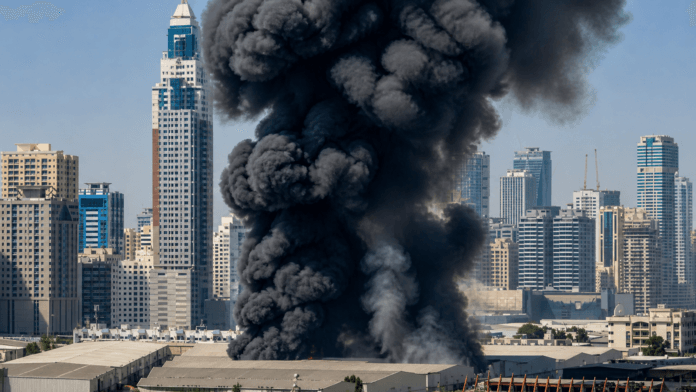
Iran has said it did not intend to target the United Arab Emirates, after Emirati authorities reported that their territory had been struck by missiles launched from Iran. According to Iranian state television, a senior unnamed official stated that Tehran “had no intention of hitting the UAE,” suggesting the incident may not have been deliberate.
The statement followed claims by the UAE Ministry of Defence that four cruise missiles, accompanied by drones, struck its territory. Officials in Abu Dhabi described the attack as a “dangerous escalation,” raising concerns about a broader spillover of tensions across the region.
Details surrounding the incident remain limited. There has been no independent verification of the exact targets, the extent of the damage, or whether there were any casualties. It is also unclear whether the missiles may have deviated from other intended targets or if the strike was part of a wider strategic signal linked to ongoing tensions.
The development comes at a sensitive moment, shortly after a fragile ceasefire between Iran and the United States. That truce had temporarily reduced tensions following a series of confrontations that had heightened fears of a wider conflict in the Middle East.
At the same time, U.S. President Donald Trump recently announced the launch of an operation aimed at restoring freedom of navigation in the Strait of Hormuz, a critical artery for global energy trade. Analysts say the move may have increased pressure on Iran and its regional posture.
The Strait of Hormuz remains one of the world’s most strategically important chokepoints, with a significant portion of global oil supplies passing through it. Any disruption or military incident in the area has immediate implications for international markets and global economic stability.
Security experts warn that even isolated incidents carry the risk of rapid escalation, particularly in a volatile environment where actions are often interpreted through the lens of broader geopolitical rivalries. In this case, the contrast between Iran’s denial and the UAE’s claims has only added to the uncertainty over what exactly occurred.
International reaction has so far been measured, with several countries urging restraint and calling for clarity. According to diplomatic sources cited in media reports, Western officials are seeking more information to determine whether this was an isolated event or part of a wider pattern of escalation.
Meanwhile, the United Arab Emirates has not indicated whether it plans to take further action in response to the reported strike. Officials have emphasized that national security remains a priority but have not outlined specific retaliatory measures.
The situation remains fluid, with global attention focused on the next moves by key regional actors. Whether this incident remains contained or evolves into a broader confrontation will likely depend on how both sides choose to respond in the coming days.