
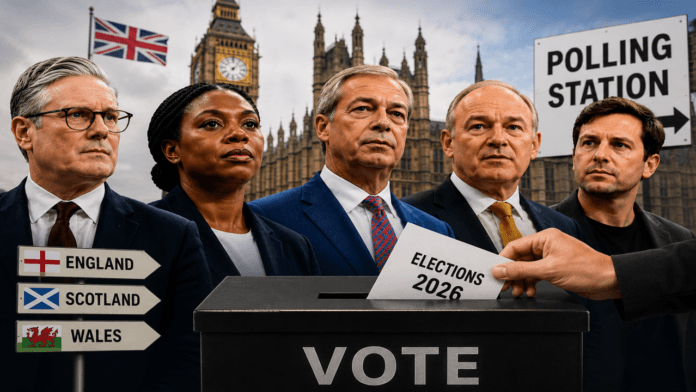
Millions of voters across the United Kingdom headed to polling stations on Thursday in one of the country’s most significant electoral tests since the 2024 general election, with local council races in England and parliamentary elections in Scotland and Wales placing Britain’s major political parties under intense scrutiny.
The elections are being closely watched as an early measure of public sentiment toward Prime Minister Keir Starmer and his Labour government, which is facing growing pressure amid concerns over the economy, migration, public services and the rising cost of living.
Polling stations opened at 7am and will remain open until 10pm, with voters choosing representatives in more than 5,000 council seats across 136 local authorities in England. At the same time, voters in Scotland are electing members of the Scottish Parliament, while voters in Wales are choosing members of the Senedd.
The scale of the elections makes Thursday one of the busiest political days in Britain in recent years. Nearly 25,000 candidates are contesting seats across the country, according to election data cited by British media reports.
Labour is defending roughly 2,500 council seats in England, placing the party in a vulnerable position if anti-government frustration translates into large electoral losses. Analysts have warned that Labour could lose hundreds of councillors, particularly if recent local polling trends continue.
Attention is also focused on Wales, where Labour’s dominance could be seriously weakened for the first time in nearly three decades. Recent polling by YouGov suggests Labour may fall to third place in the Welsh parliamentary elections, with Plaid Cymru projected to emerge as the leading force and Reform UK gaining significant support.
Such a result would mark a historic political shift in Wales, where Labour has governed continuously since the creation of the Senedd in 1999.
The rise of Reform UK, led by Nigel Farage, is also emerging as one of the defining stories of the elections. The party has fielded approximately 4,800 candidates in England, nearly matching Labour’s total and slightly surpassing the Conservatives in some areas.
Reform’s expanding presence is increasing pressure on the Conservatives, whose leader Kemi Badenoch is attempting to prevent further losses following the party’s heavy defeat in the 2024 general election.
The Liberal Democrats and Greens are likewise hoping to capitalize on voter frustration with the two dominant parties, especially in suburban and urban districts where dissatisfaction with Westminster politics remains high.
The elections are formally centered on local governance issues such as roads, education, housing, social care and waste collection. However, British local elections frequently become a broader referendum on national leadership and government performance.
That national dimension has intensified speculation surrounding Starmer’s political future. British media reports have suggested that some Labour MPs are increasingly uneasy about the government’s declining popularity and could attempt to pressure the prime minister if the results prove especially damaging.
Cabinet Office minister Pat McFadden dismissed suggestions of a leadership challenge during an interview with Sky News, insisting Starmer would continue fighting for his position if necessary.
In Scotland, the elections are also being viewed through the lens of the independence debate. First Minister John Swinney and the Scottish National Party are seeking another strong mandate at Holyrood, arguing that electoral success would strengthen demands for a second independence referendum.
A total of 129 seats are being contested in the Scottish Parliament, including 73 constituency seats and 56 regional list positions. Unlike the local elections in England, voters in Scotland are not required to present identification in order to vote in person.
In Wales, Plaid Cymru leader Rhun ap Iorwerth urged voters to support what he described as a party “with no master in Westminster,” presenting Plaid Cymru as an alternative to both Labour and Conservative influence from London.
Results are expected to begin arriving overnight, although most English councils are likely to declare their outcomes on Friday. Final counts in some areas may continue into Saturday evening.
The elections are expected to provide one of the clearest indications yet of how British voters view the political direction of the country less than two years after Labour returned to power nationally.