
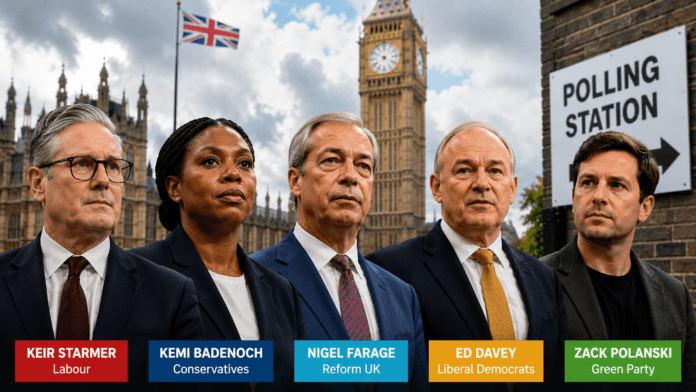
Voters in England are going to the polls on Thursday in the biggest round of local elections for three years, with more than 5,000 council seats being contested across 136 local authorities. Polling stations opened at 7am and will close at 10pm on May 7.
The elections cover a wide political map, including all 32 London boroughs, metropolitan councils, unitary authorities, district councils and several county councils. A number of mayoral contests are also taking place, adding another layer of pressure for party leaders already facing a volatile national mood.
For Labour, the vote is an early and uncomfortable test of Prime Minister Sir Keir Starmer’s government. The party is defending the largest share of seats, largely because many of them were last contested in 2022, when Labour and other opposition parties made gains against the Conservatives during the final stretch of Boris Johnson’s premiership.
That makes the political arithmetic difficult. Labour enters these elections from a position of local strength, especially in London and metropolitan boroughs, but that also means it has more to lose. Analysts Colin Rallings and Michael Thrasher have warned that both Labour and the Conservatives could face significant losses if recent voting patterns continue.
The Conservatives are also under serious pressure. Kemi Badenoch’s party is defending hundreds of seats, including in county areas where Conservative control has traditionally been strong. Reform UK’s rise has made that position more fragile, particularly in areas where right-leaning voters appear willing to punish the Tories.
Reform, led by Nigel Farage, starts from a low base in local government, which means even modest gains could be presented as a breakthrough. The Liberal Democrats and Greens are also hoping to benefit from voter frustration with the two main parties.
Local elections are formally about councils, not Westminster. Voters are choosing representatives who will shape services such as waste collection, roads, social care, planning and local education. But in practice, these contests often become a national protest vote.
That wider mood matters. The cost of living, migration, public services and the economy remain among the main concerns for voters. For many people, Thursday’s ballot is not just about who runs the council. It is a chance to send a message to the government, the opposition, or both.
Results will not arrive all at once. Only around a third of councils are expected to count overnight after polls close. Most results are likely to come during Friday, May 8, while a small number may not be completed until Saturday, May 9.
Elections are also being held in Scotland and Wales on the same day, with voters choosing members of the Scottish Parliament and the Senedd. That means Thursday’s vote will offer a broad snapshot of political sentiment across Britain, not just England.
For Starmer, the danger is that heavy Labour losses could fuel doubts about public confidence in his government. For Badenoch, another poor Conservative performance would deepen questions about whether the party is recovering or still losing ground to Reform and the Liberal Democrats.
The smaller parties face a different test. They do not only need to gain seats. They need to show momentum. Reform wants proof that its support can translate into local power. The Liberal Democrats want to strengthen their claim as the main anti-Conservative force in southern England. The Greens are looking to expand beyond their existing urban and progressive strongholds.
By the weekend, the political story may be clear. If Labour suffers large losses, pressure on Starmer will grow. If the Conservatives lose further ground, Badenoch will face fresh questions about her party’s direction. If Reform, the Liberal Democrats and Greens all advance, the elections could confirm that British politics is becoming more fragmented and less predictable.