
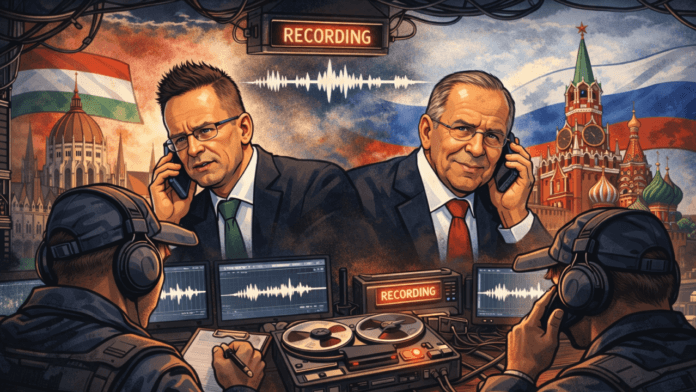
Reports of a leaked phone call between Hungary’s foreign minister and Russia’s top diplomat are fuelling concern within the European Union, with allegations that Budapest may have sought to ease sanctions on individuals linked to the Kremlin.
According to Reuters, the controversy centres on a reported conversation between Péter Szijjártó and Sergey Lavrov, said to have taken place in August 2024. The recording was obtained and verified by a consortium of investigative outlets, including Vsquare, FRONTSTORY, Delfi Estonia, The Insider and the Investigative Center of Ján Kuciak (ICJK).
In the audio, which has not been independently verified, Szijjártó is reportedly heard discussing efforts to remove a relative of a Russian businessman from the EU sanctions list. Speaking in English, he is quoted as saying that Hungary would “do everything” to secure the individual’s removal, potentially in coordination with Slovakia.
Details surrounding the recording remain unclear. It is not known how the conversation was obtained, and no official confirmation has been provided by Hungarian authorities. Russia has not publicly commented on the claims.
Szijjártó has strongly rejected the implications of the leak, describing the situation as a “major scandal”. In a statement on social media, he accused foreign intelligence services of repeatedly intercepting his communications and releasing them deliberately ahead of Hungary’s parliamentary elections.
The timing of the publication has drawn attention. Hungary is set to hold elections on April 12, with Prime Minister Viktor Orbán facing increased political pressure. Independent polling suggests the opposition Tisza party has gained momentum, although the outcome remains uncertain.
Further reporting by Vsquare and its partners points to a second alleged conversation, although no recording has been released. In that exchange, Szijjártó is said to have indicated he would support efforts to lift EU sanctions on Russia’s so-called “shadow fleet” of oil tankers, which has been widely linked to attempts to bypass Western restrictions on energy exports.
These claims have not been independently confirmed, and supporting evidence has not been made public. Slovakia’s foreign ministry declined to comment, stating it does not disclose details of its negotiating positions or those of other EU member states.
The allegations come at a sensitive moment for the European Union. Since the start of Russia’s war in Ukraine, the bloc has introduced multiple rounds of sanctions aimed at limiting Moscow’s financial and energy reach. These measures require unanimous approval, giving individual member states significant leverage in negotiations.
Hungary has frequently taken a more cautious approach than many of its European partners. While it has supported several sanction packages, Budapest has also pushed for exemptions, particularly in the energy sector. The country remains heavily reliant on Russian oil and gas, a factor officials have cited in defending their position.
Critics argue that Hungary’s stance risks undermining EU unity at a time when collective action is seen as critical. Some officials in Brussels have expressed concern that any effort to weaken sanctions could reduce pressure on Moscow and complicate support for Ukraine.
Supporters of the Hungarian government, however, maintain that its policies are driven by national interest and energy security. They argue that maintaining economic stability remains a priority, especially in the context of rising global energy costs.
The latest reports add to a broader pattern of scrutiny over Hungary’s relationship with Russia. Earlier this month, The Washington Post reported that Szijjártó had, over several years, allegedly shared information with Lavrov about internal EU discussions during private meetings. Those claims were also not independently verified and were not publicly addressed in detail by Hungarian officials.
Taken together, the developments highlight the growing tension between national policy choices and collective EU strategy. Whether the latest allegations will have a lasting political impact remains to be seen, particularly given the proximity of the elections.
For now, key details remain disputed, and the absence of independent verification leaves open questions about the full context of the reported conversations. What is clear, however, is that the issue has intensified debate within Europe over unity, trust, and the future direction of sanctions policy.