
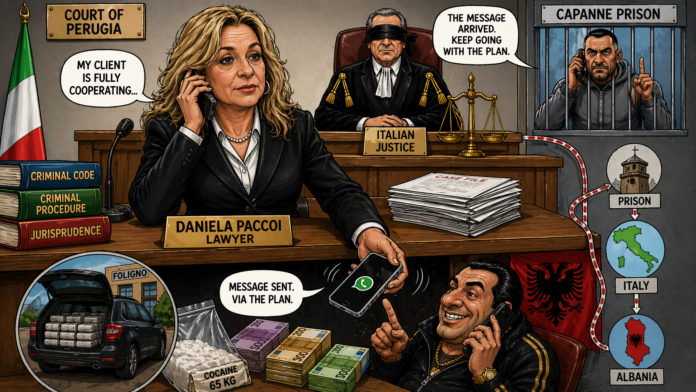
An Italian lawyer has come under criminal investigation after authorities alleged she may have acted as a key intermediary in a suspected international drug trafficking network with links to Albanian groups. Prosecutors in Perugia say Daniela Paccoi is being examined for her potential role in facilitating communication between members of the network and an imprisoned client connected to the case.
According to Italian media reports citing investigative documents, Paccoi is suspected of going beyond her legal duties, allegedly helping coordinate messages between individuals in Albania and Italy. Investigators believe she may have used her professional position to bypass scrutiny, ensuring that communications remained concealed and that the identities of those involved were protected.
However, authorities have not issued a final determination regarding her criminal responsibility. Paccoi is currently under investigation but remains free, and no formal conviction has been made. Key aspects of the case remain unclear, and several of the allegations have not been independently verified.
The case forms part of a broader probe into a suspected cocaine trafficking network operating between Italy and Albania. At the centre of the investigation is a seizure of approximately 65 kilograms of cocaine, discovered during an operation in the town of Foligno. The drugs were reportedly hidden in a vehicle and within a business premises, raising concerns about a structured and coordinated distribution system.
Another figure named in the investigation is businessman Matteo Coresi, who is reportedly the brother of a former client represented by Paccoi. According to investigators, Coresi was arrested during the same operation that uncovered the cocaine. He is suspected of having played a role in the logistical and financial management of the network, though these claims have yet to be tested in court.
Authorities from Guardia di Finanza have been closely monitoring the case through wiretaps and surveillance, including activities inside Capanne Prison, where one of the individuals linked to the case is being held. Investigators suspect that the network relied on covert communication channels to continue coordinating operations even from within detention.
One of the more sensitive elements of the investigation involves what prosecutors describe as a staged “cooperation scenario”. According to the case file, suspects may have arranged for a quantity of drugs to be hidden in a rural area near Casenova, only to later “discover” it and present the find as evidence of cooperation with authorities. If confirmed, this tactic could suggest an attempt to manipulate judicial outcomes and secure more lenient treatment.
Prosecutors also suspect that payments and other forms of influence may have been used to affect legal proceedings. At this stage, however, there is no publicly confirmed evidence supporting these claims, and investigations are ongoing to determine the extent of involvement of each individual.
The case is expected to reach a more decisive phase in early May, when Matteo Coresi is due to appear in court under a fast-track procedure. This hearing could provide further clarity on the structure of the alleged network and the roles played by those under investigation, including Paccoi.
The developments have raised broader concerns in Italy about the potential misuse of legal professionals in criminal operations. While the vast majority of lawyers operate within the law, cases like this highlight how professional roles could be exploited in complex international networks.
The alleged involvement of individuals linked to Albanian groups has also drawn attention to ongoing concerns over cross-border drug trafficking in the region. Experts note that such investigations are often lengthy and complex, requiring substantial evidence before any definitive conclusions can be reached.
For now, the case remains open, with many details yet to be confirmed. Italian authorities have not provided a timeline for the conclusion of the investigation, and it remains uncertain whether formal charges will be brought against the lawyer.