
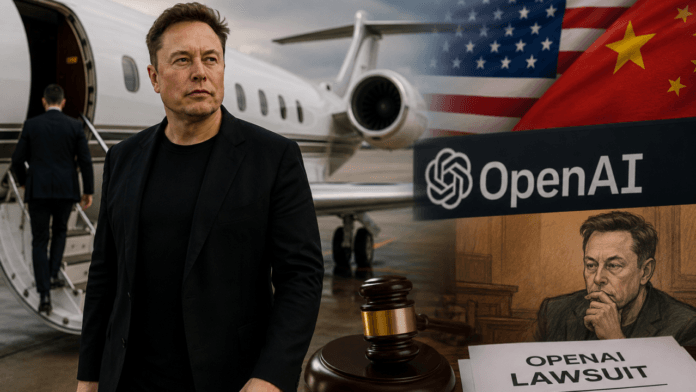
Elon Musk reportedly traveled to China alongside Donald Trump during the president’s state visit, despite having been warned by a federal judge that he could be called back to testify in the high-profile legal dispute involving OpenAI.
The development has drawn attention because Musk remains a central figure in the closely watched case against OpenAI, the artificial intelligence company he co-founded before later becoming one of its most outspoken critics. The lawsuit centers on allegations that the company abandoned its original nonprofit mission by moving toward a profit-driven corporate structure.
According to reports cited by NBC News, Musk testified in the trial last month in Oakland, California. Before he stepped down from the witness stand on April 30, U.S. District Judge Yvonne Gonzalez Rogers reportedly asked attorneys whether there was any reason to keep Musk on what is known as “recall status,” meaning he could potentially be summoned again during proceedings.
Lawyers representing OpenAI responded that they wanted to preserve that option.
“In order, Mr. Musk, you are not excused, but you may leave for today,” Rogers reportedly told the billionaire entrepreneur during the hearing. At the time, details surrounding Trump’s eventual China trip had not yet been finalized publicly.
Despite that warning, Musk later departed the United States as part of the presidential delegation heading to China. The move has triggered debate among legal analysts over whether such travel is appropriate while testimony in a major federal case remains unresolved.
Jeffrey Bellin, a law professor at Vanderbilt University, told NBC News that a typical witness facing the possibility of recall would normally avoid international travel during an active proceeding.
“A typical witness would not leave the country if they could be called back,” Bellin reportedly said.
So far, there is no indication that Musk violated any court order. Legal experts note that being kept on recall status does not automatically prohibit a witness from traveling abroad, particularly if the court has not imposed explicit restrictions. Details about whether OpenAI’s legal team plans to seek additional testimony from Musk remain unclear.
The case itself has become one of the most closely followed disputes in the artificial intelligence industry, largely because it touches on broader concerns about corporate control, AI safety, transparency and the future direction of advanced AI systems.
Musk has repeatedly argued that OpenAI shifted away from the principles on which it was founded. He has claimed the organization was initially established to develop artificial intelligence for the benefit of humanity rather than for commercial gain. OpenAI has denied wrongdoing and defended its current structure as necessary to secure the enormous levels of funding required to build advanced AI technologies.
The dispute also reflects the increasingly personal and competitive divide between Musk and OpenAI leadership, particularly after the global success of ChatGPT transformed the company into one of the most influential firms in the technology sector.
Musk, who later launched his own AI venture, xAI, has publicly criticized OpenAI on multiple occasions, accusing the company of becoming too closely aligned with corporate interests and major investors.
Meanwhile, Trump’s visit to China has itself attracted global attention due to the tense geopolitical climate between Washington and Beijing. The inclusion of Musk in the broader orbit of the trip is significant because of Tesla’s extensive business interests in China. Tesla relies heavily on its Shanghai operations, which remain one of the company’s most important production hubs worldwide.
China has become a crucial market for Tesla, even as economic and political tensions between the United States and China continue to affect trade, technology partnerships and strategic industries.
Neither Musk nor OpenAI publicly commented immediately on the controversy surrounding his travel during the ongoing proceedings. The White House also did not issue any formal clarification regarding Musk’s role during the visit.
Legal observers say the situation highlights how unusual the case has become, blending Silicon Valley rivalries, questions over the future of artificial intelligence and the influence of some of the world’s most powerful political and business figures.
The trial is expected to continue drawing attention as the battle over OpenAI’s governance and business model unfolds in court. It could also have wider implications for how AI companies structure themselves in the future, particularly as governments around the world increase scrutiny over artificial intelligence development and corporate accountability.
For now, however, questions remain over whether Musk will be required to return to court for additional testimony and how the judge overseeing the case may respond if further appearances become necessary.