
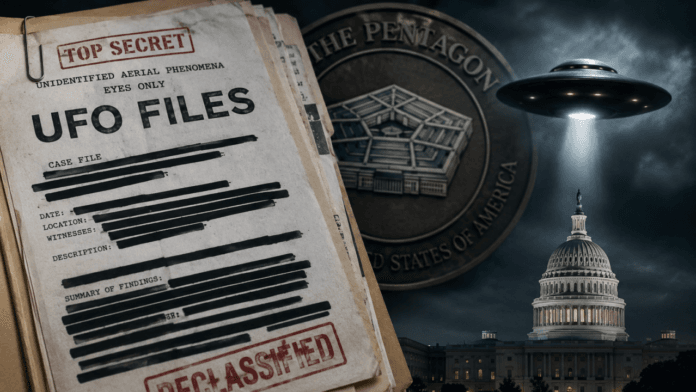
The latest wave of declassified Pentagon material related to UFO investigations has sparked a debate that extends far beyond the usual question of whether extraterrestrial life exists. For some scholars, the issue has more to do with how modern societies build meaning, trust and collective identity at a time when traditional institutions appear to be losing authority.
In an opinion article published by The Washington Post, Diana Walsh Pasulka, a professor of religious studies at the University of North Carolina, argued that the growing fascination with UFOs should no longer be dismissed as simple pop culture curiosity or fringe conspiracy thinking. According to her, the phenomenon is increasingly performing functions historically associated with religion, including creating narratives of transformation, offering explanations about humanity’s place in the universe and forming communities built around shared belief.
Pasulka noted that the recently released files do not prove the existence of alien life. That distinction remains important. The documents may add transparency to reports involving unidentified aerial phenomena, but they do not provide definitive answers about their origins.
Still, she argues that the very act of creating an official government archive around such cases gives the phenomenon a new level of legitimacy in the public sphere. It is not an endorsement of a doctrine, but rather the establishment of a framework where citizens are encouraged to search for hidden truths surrounding a subject once treated as marginal.
Belief in UFOs, as Pasulka describes it, does not operate like a traditional religion. There is no central institution, no universally accepted sacred text and no authority defining what followers should believe. That absence of hierarchy, however, may be exactly what makes the phenomenon compatible with the digital age.
Communities centered around UFO discussions now operate largely through podcasts, social media platforms, online forums and independent video channels. A blurry image in the sky, testimony from a pilot or a newly declassified report can quickly become the subject of mass interpretation and speculation. In this environment, belief spreads horizontally through networks rather than vertically through institutions.
The movement also carries a strong anti institutional dimension. Many supporters express distrust toward governments, mainstream media, academic science and even organized religion. According to Pasulka, however, that skepticism is no longer confined to isolated fringe groups. Interest in UFOs has increasingly entered mainstream political and cultural discussions involving former officials, journalists, military personnel and academics.
That does not mean every claim should be accepted as factual. On the contrary, the lack of verifiable evidence makes it even more important to distinguish between documented facts, personal testimony and interpretation. Many reported incidents remain unexplained, but “unexplained” does not automatically mean extraterrestrial.
This tension lies at the center of the modern UFO debate. Science demands evidence that can be tested and replicated. Belief, meanwhile, often exists in the space between certainty and mystery. UFO phenomena occupy that uncertain territory where the absence of definitive answers frequently strengthens public fascination instead of weakening it.
Popular culture has also played a major role in shaping perceptions around the subject. Films, television series and books involving aliens, hidden technologies and secret government programs have spent decades building a collective mythology around UFOs. Productions such as The X-Files, Star Trek and Star Wars did not create belief in extraterrestrials, but they helped define the language through which many people interpret the unknown.
In that sense, the declassification of UFO documents is not simply a bureaucratic or national security matter. It becomes part of a broader cultural story in which citizens increasingly search for meaning outside traditional systems of authority and build alternative frameworks of interpretation.
Pasulka sees this as evidence of a deeper transformation taking place within American society. According to her analysis, religious impulses have not disappeared in a more technological and secular world. Instead, they have migrated into new spaces where mystery, technology, skepticism and existential questions merge into modern forms of belief.
Ultimately, the declassified UFO files may not provide the answers many people are hoping for. They may not reveal proof of extraterrestrial life and many questions could remain unresolved for years. But they do reveal something important about the current moment: in a society where trust in institutions has weakened, even the sky can become a place where people search for meaning.