
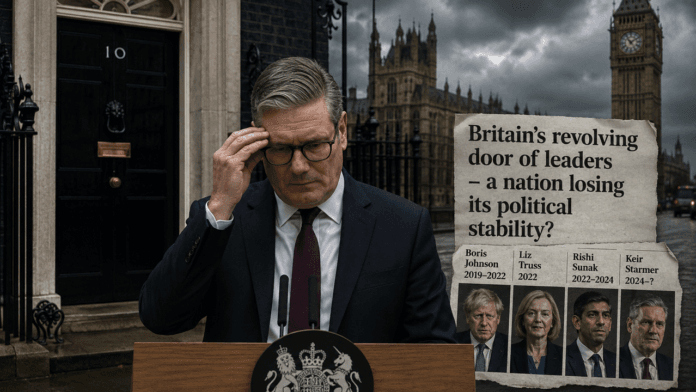
Britain once exported its model of government to the world. Westminster democracy, the civil service and parliamentary tradition were viewed as symbols of political maturity and institutional stability. Today, however, the United Kingdom is increasingly facing a different reputation: a country trapped in political turbulence, short-term leadership and declining public confidence.
The pressure surrounding Prime Minister Keir Starmer illustrates the scale of that transformation. Less than two years after securing a historic election victory for the Labour Party in 2024, Starmer is reportedly fighting to maintain authority inside his own government amid growing political dissatisfaction and economic strain.
Britain has now had six prime ministers in just over a decade. The rapid turnover accelerated dramatically in recent years, with Boris Johnson, Liz Truss, Rishi Sunak and Starmer all occupying Downing Street within a four-year period. Alongside them came repeated changes at the Treasury and Foreign Office, creating a level of instability that many analysts argue is damaging Britain’s ability to govern effectively.
For decades, Britain’s political strength rested not only on elections, but on continuity. Governments changed, but institutions remained solid and experienced. That balance now appears weaker. Questions are increasingly being asked in British political circles about whether the problem lies with individual leaders or with the wider system itself.
The concerns go beyond party politics. Critics argue that both Westminster and Whitehall are struggling to adapt to modern pressures. Parliament is often described as outdated in both structure and procedure, while the quality and experience of elected representatives are seen by some observers as declining compared with previous generations.
At the same time, Britain’s civil service, once viewed internationally as one of the world’s most effective administrative systems, has also come under increasing criticism. Senior officials with decades of institutional knowledge have gradually left government service, while political appointments and short-term advisers have gained more influence.
The result, according to critics of the current system, is a government increasingly driven by media cycles, polling data and online reaction rather than long-term planning. The rise of 24-hour political coverage and constant digital scrutiny has intensified pressure on leaders to deliver immediate results, even when many national challenges require years to resolve.
Britain’s problems are also becoming more complex at the same time. The country is dealing with weak productivity growth, rising public debt, high energy costs, pressure on public services and continuing debate over immigration. The economic aftershocks of the pandemic, combined with the wider impact of the wars in Ukraine and the Middle East, have further complicated the picture.
Political fragmentation is adding another layer of uncertainty. Britain’s two dominant parties, Labour and the Conservatives, have historically provided stability through long periods of alternating government. But growing support for smaller and protest movements, including Reform UK, is reshaping the political landscape. Some analysts now openly discuss the possibility that Britain’s traditional two-party structure could weaken dramatically over the next decade.
The role of prime minister itself has also changed significantly. Modern leaders are expected to operate continuously under enormous public scrutiny while managing domestic crises, geopolitical tensions and economic shocks simultaneously. The office demands relentless decision-making, political resilience and the ability to recover quickly from setbacks, often in full public view.
Several recent British leaders demonstrated political strengths before entering Downing Street. Theresa May built a reputation at the Home Office, Johnson gained national visibility as Mayor of London, Truss served in senior cabinet positions and Starmer performed strongly as opposition leader. Yet many observers argue that succeeding in individual government roles no longer guarantees the ability to survive the pressures of the premiership itself.
Experience is another growing concern. Previous generations of British prime ministers often arrived in office after years managing multiple departments inside Whitehall. Critics say many modern political leaders reach the top with far less administrative experience than their predecessors, weakening their ability to control government machinery during crises.
The personal toll of the office also remains severe. British political history is filled with leaders who left Downing Street exhausted, politically isolated or forced out by their own parties. Behind cabinet unity often sits intense internal rivalry, especially when governments begin losing public support.
The danger for Britain is not only political instability, but economic vulnerability. Analysts increasingly warn that prolonged weak leadership could eventually collide with financial market pressure. Britain has previously survived major crises, including the IMF crisis of 1976, Black Wednesday in 1992 and the global financial crash of 2008, partly because strong governments were still able to maintain institutional confidence. Critics fear future crises may become more difficult to manage if political fragmentation continues.
Supporters of institutional reform argue that Britain now requires deeper structural changes rather than another short-lived change of leadership. That includes rebuilding the civil service, restoring long-term policy planning and reducing dependence on politically loyal advisers in favour of experienced administrators.
Others believe the country’s next prime minister will need something increasingly rare in modern politics: patience, experience and a clearly defined long-term vision capable of surviving beyond daily headlines and polling cycles.
For now, Britain remains one of the world’s largest economies and continues to hold significant international influence. But the growing instability at the heart of its political system is raising uncomfortable questions about whether the country that once defined modern parliamentary government can still effectively govern itself.