
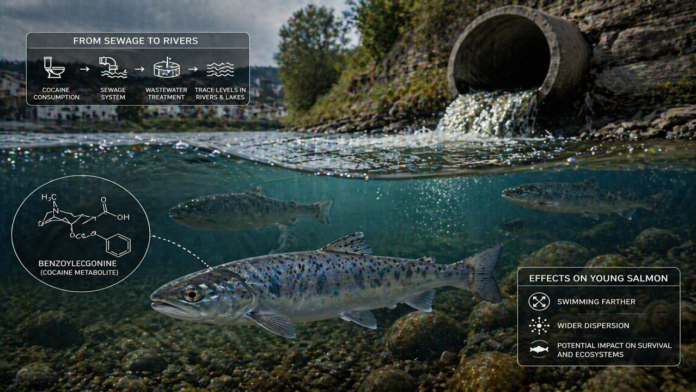
A new study suggests that cocaine contamination in waterways is affecting the behaviour of young Atlantic salmon, altering how they move and interact with their environment.
Researchers from Griffith University found that exposure to cocaine-related compounds caused juvenile salmon to swim further and spread more widely across their habitat. The findings mark the first evidence of such effects being observed in wild fish rather than controlled laboratory settings.
The study, published in Cell Press, tracked more than 100 young salmon over an eight-week period in Lake Vättern in Sweden. Scientists monitored how exposure to cocaine and its main metabolite influenced the fishes’ movement patterns.
Fish exposed to benzoylecgonine, a primary byproduct of cocaine commonly found in wastewater, were observed to swim roughly twice as far each week compared to unexposed fish. They also dispersed up to 12.3 kilometres further across the lake.
According to the researchers, these behavioural changes became more pronounced over time, suggesting that prolonged exposure significantly alters how fish use their natural habitat.
“Where fish go determines what they eat, what eats them and how populations are structured,” said Marcus Michelangeli, one of the study’s authors. “If pollution is changing these patterns, it has the potential to impact ecosystems in ways we are only beginning to understand.”
Cocaine and its derivatives are increasingly being detected in rivers and lakes worldwide. They typically enter water systems through wastewater treatment plants, which are not designed to fully remove such chemical compounds.
Previous research had already indicated that cocaine could influence fish behaviour, but those findings were limited to laboratory environments. This latest study provides evidence that similar effects are occurring in natural ecosystems.
Despite the findings, researchers stressed that the study does not indicate a direct risk to humans consuming fish. The salmon examined were juvenile and far smaller than those typically caught for food.
Still, the broader implications raise concerns about long-term environmental impact. Scientists say the presence of human-derived substances in aquatic systems is becoming more widespread and may have complex effects on wildlife.
“The idea that cocaine affects fish may seem surprising, but wildlife is already exposed to a wide range of human-derived drugs every day,” Michelangeli added.
Researchers now hope to expand their work to better understand how these behavioural changes affect survival and reproduction, and to identify which species may be most at risk.