
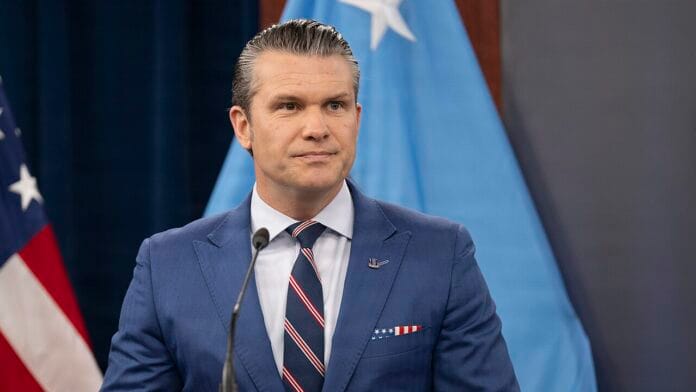
U.S. Defense Secretary Pete Hegseth said on Wednesday that American forces had achieved what he described as a “historic and overwhelming victory” against Iran, while making clear that troops would remain deployed in the region to enforce a fragile ceasefire.
Speaking at a Pentagon press briefing, Hegseth framed the outcome of the recent military campaign as decisive, crediting U.S. and allied forces with dismantling key elements of Iran’s military infrastructure. His remarks came a day after Donald Trump announced a two-week pause in hostilities as part of ongoing negotiations aimed at securing a longer-term settlement.
“We’ll be hanging around. We’re not going anywhere,” Hegseth said, adding that U.S. forces remain ready to resume operations “at a moment’s notice” if the situation deteriorates.
However, details of the emerging agreement remain limited, and officials have yet to publish the full framework of what Trump described as a preliminary 15-point peace plan. It is unclear which provisions have been formally agreed upon by both sides, and no independent verification has been made public.
The uncertainty surrounding the ceasefire was underscored by comments from Vice President JD Vance, who described the situation as a “fragile truce” that could collapse in the coming days. Vance, speaking during a political visit abroad, suggested that tensions in the region remain high despite the pause in fighting.
That contrast in tone points to a broader divide within Washington over how stable the current situation really is. While Hegseth expressed strong confidence that the deal would hold, others appear more cautious, warning that underlying risks have not been resolved.
The U.S. military campaign, launched on February 28 under what officials have referred to as Operation Epic Fury, has involved sustained air and naval strikes across multiple targets inside Iran. According to Dan Caine, American forces have carried out more than 13,000 strikes since the operation began.
These included attacks on roughly 80 percent of Iran’s air defense systems, more than 1,500 air defense targets, and hundreds of missile storage facilities and drone launch sites. U.S. officials also reported extensive operations in the strategically critical Strait of Hormuz, where naval mines and related assets were targeted.
Caine said that more than 700 strikes had been conducted against maritime threats in the area, which he estimated accounted for around 95 percent of Iran’s mine stockpiles. The Strait is a vital artery for global energy supplies, with roughly a quarter of the world’s crude oil trade passing through it.
Its partial closure during the conflict contributed to sharp volatility in global energy markets, raising concerns among governments and investors alike. Hegseth indicated that under the terms of the ceasefire, shipping lanes through the waterway are expected to reopen fully, though this has not yet been independently confirmed.
Despite the scale of the military campaign, questions remain about its long-term impact. Analysts have cautioned that while infrastructure may have been significantly degraded, Iran retains asymmetric capabilities, including proxy networks across the region.
Reports of overnight activity involving Iran-aligned groups have already surfaced, though Hegseth downplayed these incidents, saying they did not constitute a breach of the agreement. Still, he issued a warning that U.S. forces remain prepared to respond swiftly if necessary.
“Iran would be wise,” he said, “to ensure its forces understand the terms of this arrangement,” in remarks that appeared aimed at deterring potential violations.
The broader geopolitical picture remains complex. The conflict, which lasted several weeks, marked one of the most intense direct confrontations between the United States and Iran in recent years. It also drew in regional dynamics, including coordination with Israeli forces, according to U.S. officials.
Yet the absence of formal confirmation from Tehran on key aspects of the deal leaves open critical questions about its durability. Iranian authorities have not publicly detailed their position on the ceasefire terms, and independent observers say it is too early to assess whether the pause in fighting will translate into a lasting peace.
For now, Washington appears to be balancing a message of strength with a recognition that the situation remains fluid. The continued presence of U.S. forces in the region reflects both a deterrence strategy and an acknowledgment that the ceasefire, while significant, may only be temporary.
As negotiations continue, much will depend on whether both sides adhere to the terms of the agreement and whether underlying tensions can be addressed through diplomacy rather than force.