
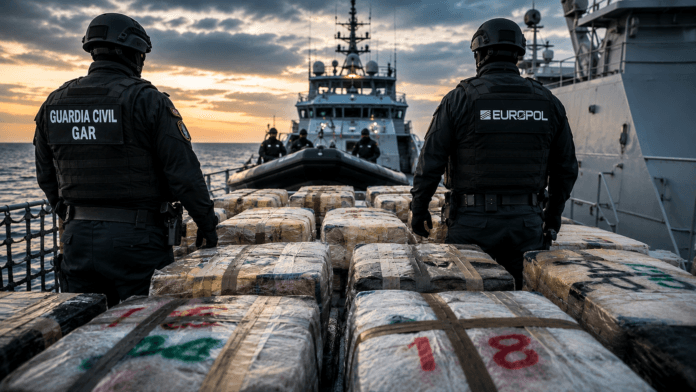
A major international law enforcement operation coordinated by Europol and led by the Guardia Civil has disrupted what investigators described as a key Atlantic drug trafficking corridor linking Latin America to Europe.
According to Europol, the operation targeted criminal networks using complex maritime transfer systems to move cocaine across the Atlantic while avoiding Europe’s largest commercial ports and traditional customs inspections.
The enforcement phase of the operation took place between April 13 and April 26, 2026, with authorities deploying maritime assets across large sections of the Atlantic Ocean to detect, monitor and intercept suspect vessels involved in offshore drug transfers.
Investigators focused heavily on the eastern Atlantic corridor between the Canary Islands and the Azores, an area that authorities say has increasingly become a preferred route for transnational trafficking groups.
In total, authorities seized 11 tons of cocaine and 8.5 tons of hashish during the operation. Officials also confirmed the arrest of 54 suspects and the interception of eight vessels believed to be linked to the smuggling network.
The latest crackdown comes after Europol warned earlier this year that organized crime groups were adapting their trafficking strategies by moving cocaine shipments away from heavily monitored European ports and toward fragmented maritime routes across the Atlantic.
According to investigators, criminal organizations have increasingly relied on multi-stage offshore logistics systems designed to reduce exposure to customs controls and law enforcement surveillance.
Under this method, so-called “mother ships” depart from Latin America carrying large cocaine shipments before traveling hundreds or even thousands of nautical miles into international waters.
These vessels can include cargo ships, fishing boats, bulk carriers or smaller non-commercial maritime platforms operating far from traditional inspection zones.
Once in remote areas of the Atlantic, traffickers reportedly transfer the narcotics to high-speed vessels capable of long-distance crossings. Authorities said these include rigid inflatable boats and other fast maritime craft specifically adapted for covert transport operations.
In the final stage of the route, the cocaine is allegedly redistributed again onto smaller vessels before being landed on isolated coastlines in Portugal and Spain.
Law enforcement officials say traffickers frequently use remote beaches, small marinas and lightly monitored coastal areas to avoid detection by authorities.
Europol said the structure is specifically designed to fragment operational risk across multiple crews, vessels and transfer points, making investigations more difficult and limiting the exposure of higher-level organizers.
The agency added that the latest operation directly targeted this decentralized maritime model by intercepting shipments before they could reach European territory.
Officials did not publicly disclose the nationalities of all those arrested, and details about the broader criminal organizations involved remain limited as investigations continue.
The operation highlights the growing importance of maritime intelligence and cross-border cooperation in Europe’s anti-drug strategy, particularly as trafficking groups continue adapting to pressure at major ports such as Port of Rotterdam and Port of Antwerp.
European authorities have repeatedly warned that cocaine trafficking into the continent has reached record levels in recent years, with organized crime groups investing heavily in logistics, encrypted communications and international shipping networks.
Analysts say the Atlantic route has become increasingly attractive because it allows traffickers to bypass tighter security controls introduced at some of Europe’s busiest commercial gateways.
The latest seizures are also likely to renew concerns about the role of transnational criminal alliances connecting Latin American cartels with European organized crime groups involved in distribution, money laundering and logistics support.
While Europol described the operation as one of the clearest results yet against the evolving maritime trafficking model, officials cautioned that criminal networks are expected to continue adapting their methods.
Authorities across Europe are now expected to intensify maritime surveillance and intelligence-sharing efforts in an attempt to prevent traffickers from opening new offshore supply corridors into the continent.