
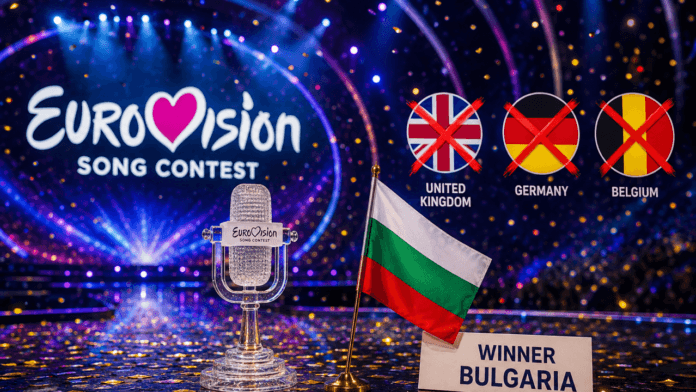
The 70th edition of the Eurovision Song Contest 2026 ended in celebration for some countries and complete disappointment for others, as Britain, Germany and Belgium suffered one of the harshest outcomes possible in the competition: zero points from the public vote.
The contest, hosted this year in Vienna, saw all three countries fail to connect with European audiences despite highly publicized performances and months of promotion ahead of the grand final.
For the United Kingdom, the result added another painful chapter to its increasingly difficult relationship with Eurovision. British representative Sam Battle, widely known online as “Look Mum No Computer,” performed the song “Eins, Zwei, Drei” during the final, but failed to secure any televote points from viewers across Europe.
The performance had generated curiosity before the contest because of its unusual electronic style and German-language title, but the experiment ultimately failed to resonate with audiences on the night.
Britain’s Eurovision struggles in recent years have often become a source of debate inside the country, particularly given its strong music industry and global cultural influence. The notable exception remains Sam Ryder, who achieved a major breakthrough for the UK at the 2022 Eurovision contest in Turin.
Ryder finished second with the song “Space Man,” collecting 466 points and delivering Britain’s best Eurovision result since 1998. His performance was widely praised for its vocal range, stage presence and emotional delivery, and he later became one of the contest’s most commercially successful recent contestants.
Before Eurovision, Ryder had built a large following online during the coronavirus pandemic by posting musical performances on social media platforms, helping him gain international recognition.
Germany also endured a disastrous night in Vienna. Representing Germany, singer Sarah Engels performed the track “Fire,” but the entry failed to attract support from televoters and ended the competition without receiving any audience points.
Belgium faced a similar outcome. Belgian representative Essyla performed “Dancing on the Ice,” but likewise finished with zero points from the public vote, placing the country among the biggest disappointments of the evening.
The results highlighted once again how unpredictable Eurovision voting can be, where elaborate staging and strong domestic support do not always translate into success with international audiences.
A total of 25 countries competed in the grand final. Victory ultimately went to Bulgaria, with singer Dara winning the competition with the song “Banagaranga.” Israel finished in second place after another highly competitive performance.
However, this year’s contest was also overshadowed by political controversy and growing divisions surrounding Israel’s participation.
According to reports surrounding the event, Spain, Netherlands, Ireland, Slovenia and Iceland withdrew from Eurovision 2026 in protest after organizers allowed Israel to remain in the competition amid the ongoing war in Gaza.
The withdrawals sparked heated reactions online and intensified wider debates over whether political issues should influence participation in international cultural events such as Eurovision.
Organizers of the competition have repeatedly defended Eurovision as a non-political event, although the contest has increasingly become entangled in geopolitical controversies in recent years.
Social media reaction to this year’s final was immediate and intense. Many viewers mocked the zero-point results suffered by Britain, Germany and Belgium, while others argued the televote system has become increasingly unpredictable and driven by viral moments rather than musical quality alone.
Despite the criticism, Eurovision 2026 once again demonstrated its enormous cultural reach across Europe and beyond, attracting millions of viewers and dominating online discussion throughout the weekend.
For Britain, Germany and Belgium, however, Vienna will likely be remembered less for celebration and more for one of the most embarrassing scoreboard outcomes possible on the Eurovision stage.