
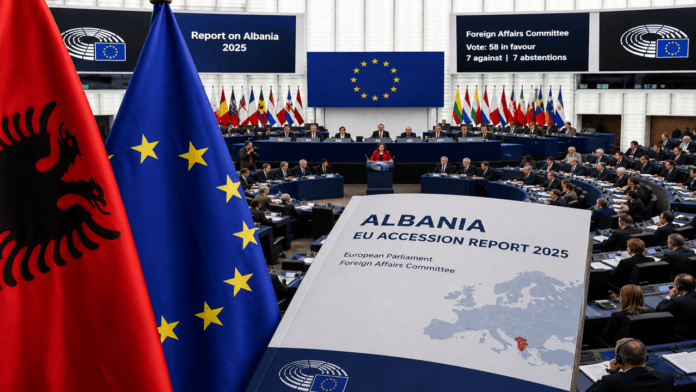
The European Parliament’s Foreign Affairs Committee has approved its latest report on Albania, marking a key step before the document moves to a plenary vote, according to official results from the session.The report, drafted by Andreas Schieder, was adopted with 58 votes in favour, seven against and seven abstentions. It assesses Albania’s progress toward European Union membership and outlines both achievements and remaining challenges.Speaking during the session, Schieder said Albania is viewed as one of the two leading candidates in the current EU enlargement process, echoing earlier remarks by Enlargement Commissioner Marta Kos. He stressed, however, that reforms must go beyond formal adoption and be felt in citizens’ daily lives.“Reforms should not remain on paper. They must translate into real improvements, particularly in social conditions,” Schieder said. While the report signals optimism, including the possibility that Albania could be ready for accession by 2027, officials cautioned that this timeline depends heavily on sustained and credible reform implementation.
Strong progress, but reforms must be irreversible
The report acknowledges Albania’s rapid advancement in the accession process. The country, an EU candidate since 2014, formally opened negotiations in July 2022 and completed the screening process by late 2023. Between October 2024 and November 2025, all negotiation clusters were opened, marking an unusually fast pace.
The European Parliament welcomed this momentum and Albania’s consistent alignment with the EU’s Common Foreign and Security Policy. Enlargement, the report notes, remains a strategic investment in peace, stability and democratic development across Europe.
Judicial reforms and the vetting process are ongoing, but delays in court cases and risks of political interference remain issues.
Still considered a serious concern, particularly at high levels. The report calls for stronger investigations and more consistent convictions.
Continued cooperation with EU agencies such as Europol and Eurojust is encouraged.
While the legal framework is broadly adequate, concerns persist over misuse of state resources, allegations of vote-buying and pressure on voters.
However, MEPs stressed that credibility in the enlargement process depends on strict conditionality and merit-based progress. Passing laws alone is not enough. Effective implementation and long-term sustainability are seen as critical.
Political climate and institutional challenges
The report also raises concerns about political polarisation, warning that confrontational rhetoric continues to undermine democratic institutions.
MEPs urged:
- stronger parliamentary oversight
- greater legislative transparency
- deeper engagement with civil society
Public administration reform remains another priority, with calls for depoliticisation and merit-based recruitment.
Media freedom and fundamental rights
On fundamental rights, the report stresses the need to strengthen freedom of expression and media pluralism. It also highlights the importance of protecting vulnerable groups, including minorities, migrants and people with disabilities.
Concerns were raised about anti-gender rhetoric and the need to ensure equal access to justice for all citizens.
Economic reforms and environmental gaps
Economically, Albania’s participation in the EU Growth Plan for the Western Balkans was welcomed. However, structural weaknesses remain, including:
- high levels of informality
- low productivity
- need for stronger investment in education and innovation
The report also flags limited progress in environmental and climate policies, urging more decisive action in these areas.
Foreign policy alignment and regional cooperation
Albania received positive recognition for maintaining full alignment with EU foreign and security policy, a key factor in its accession path.
MEPs also stressed the importance of maintaining good neighbourly relations and regional cooperation, seen as essential for long-term stability in the Western Balkans.
EU support tied to reforms
The European Parliament welcomed continued EU financial and technical assistance to Albania but underlined that such support must remain closely linked to reform progress.
The report will now move to a plenary vote in the European Parliament, where it could further shape the political direction of Albania’s EU accession process.