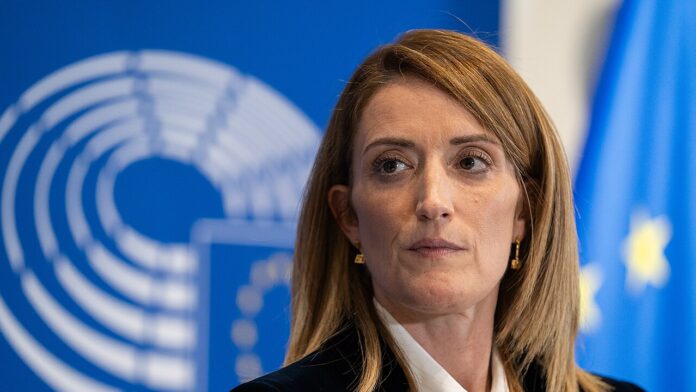
European Parliament President Roberta Metsola has praised Albania’s progress toward European Union membership, describing the country as one of the leaders in the current enlargement process.
Speaking about developments in the Western Balkans, Metsola said that Albania and Montenegro are at the forefront of EU accession efforts. She underlined that the European perspective continues to act as a key driver shaping political and institutional reforms across the region.
Her remarks come shortly after similar comments from Marta Kos, who has also highlighted Albania’s steady progress. According to statements made in recent days, Kos pointed to the country as one of the candidates advancing consistently in its path toward EU integration.
In an interview with BBC News, Kos said that Albania is moving forward at a solid pace, adding that the coming years could see new EU member states, provided candidate countries maintain their reform momentum. However, she did not specify a timeline for Albania’s potential accession.
“We have Montenegro, which is the most advanced. We have Albania, which is progressing well, as well as Moldova,” Kos said, according to the interview. “These three countries, and possibly Ukraine, if they continue reforms, could move forward. I hope that during my mandate we will see at least one new member state.”
The European Union’s enlargement policy has gained renewed attention in recent years, particularly in light of geopolitical developments and the bloc’s efforts to strengthen ties with neighboring regions. The Western Balkans, long seen as a strategic priority, remain central to this agenda.
Albania officially opened accession negotiations with the EU in 2022, alongside North Macedonia, marking a significant step forward after years of preparatory reforms. Since then, the country has been working through screening processes and aligning its legislation with EU standards.
Despite the positive assessments, officials in Brussels have repeatedly stressed that progress depends on sustained reforms, particularly in areas such as the rule of law, judiciary independence, and the fight against corruption. These conditions remain key benchmarks for all candidate countries.
Analysts note that the supportive tone from senior EU figures reflects both Albania’s internal progress and the EU’s broader strategic interest in maintaining stability and influence in the Western Balkans. However, they caution that the accession process remains complex and often lengthy.
For Albania, continued momentum will depend on maintaining reform pace and meeting technical criteria, while also navigating regional dynamics and EU internal debates over enlargement.
At this stage, while optimism appears to be growing, there is still no confirmed timeline for membership. The coming years are likely to be decisive in determining whether Albania can translate political support into concrete steps toward joining the European Union.