
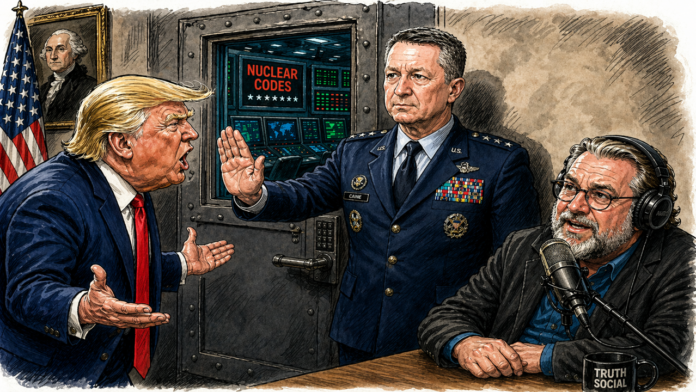
Claims that former US President Donald Trump was denied access to US nuclear launch codes by a senior military official have surfaced online, but remain unverified and without official confirmation.
The allegation was made by Larry Johnson, a former CIA officer who now works as a security analyst. Speaking in a podcast broadcast on YouTube, Johnson said Trump was allegedly blocked from accessing nuclear codes during a reported interaction on April 18.
According to Johnson’s account, Trump attempted to access the codes but was refused by a senior military figure identified as Dan Kein. Johnson claimed the general intervened directly, reportedly saying “No” and preventing the action.
However, these claims have not been independently verified, and there has been no confirmation from US government officials, the Department of Defense, or any credible institutional source. Details surrounding the alleged meeting remain unclear.
Johnson further suggested that the military official acted under authority tied to command protocols governing nuclear weapons use. In US doctrine, nuclear weapons are typically reserved for extreme scenarios involving existential threats to the country.
Experts note that while the US nuclear command system includes multiple safeguards and verification layers, the exact decision-making process is highly classified. It is also widely understood that the president holds primary authority over nuclear launch decisions, though military officers are expected to assess the legality of any order.
The suggestion that a general could unilaterally “veto” presidential access to nuclear codes is not publicly established as part of formal doctrine. Analysts say the reality is more complex, involving legal review, authentication procedures, and chain-of-command protocols rather than a single-point refusal.
The claim also emerges against the backdrop of broader geopolitical tensions, including ongoing concerns over Iran. Johnson reportedly argued that, under existing US doctrine, a conflict involving Iran would not automatically meet the threshold of an existential threat to justify nuclear use.
There has been no response from Trump or his representatives regarding the claims. Similarly, US military authorities have not issued any statement addressing the allegations.
Given the lack of corroborating evidence, the account should be treated with caution. Analysts emphasize the importance of relying on verified information when discussing matters as sensitive as nuclear command authority.