
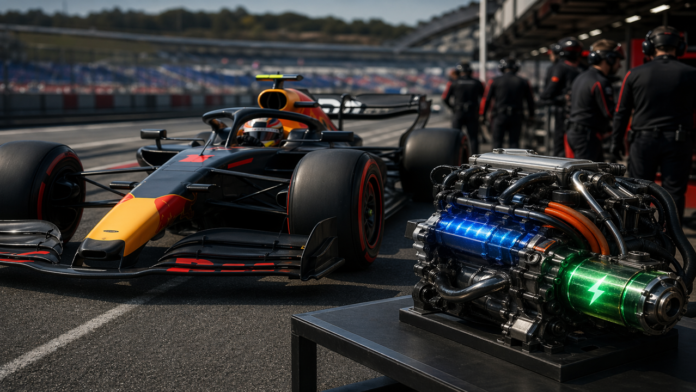
Formula 1 has approved a series of rule changes aimed at easing the issues created by its new engine regulations, following growing concerns from drivers and teams.
The new power-unit system, which features a near 50-50 split between internal combustion and electrical energy, has significantly increased the need for energy management during both races and qualifying sessions. Drivers have argued that this has made the cars less intuitive to drive and has limited their ability to push naturally on track.
Among the most vocal critics has been Max Verstappen, who has suggested that his dissatisfaction with the current direction of Formula 1 could even influence his long-term future in the sport.
The newly approved changes focus on two main areas: allowing drivers to push harder during qualifying and reducing large speed differentials during races, particularly when one car has full battery deployment and another has little or no electrical charge.
In qualifying, the FIA has reduced the amount of energy that can be recovered over a lap. The aim is to prevent drivers from being forced into artificial techniques such as lifting off the throttle before braking, which has been widely criticised as counter-intuitive. At the same time, limits on energy recovery in certain phases have been adjusted to allow for more consistent flat-out driving.
During races, the changes are also designed with safety in mind. The FIA wants to avoid dangerous situations where a car with full electrical power rapidly closes in on another running at reduced deployment. This issue was highlighted in the high-speed incident involving Oliver Bearman at the Japanese Grand Prix.
As a result, maximum electrical power will no longer be available throughout the entire lap. Drivers will be able to deploy full power in acceleration zones, while in other sections of the circuit deployment will be restricted to reduce extreme speed differences.
Formula 1 has also introduced measures for wet conditions. Following driver feedback, tyre blanket temperatures will be increased to improve initial grip, while electrical deployment will be limited further to help with car control in low-traction conditions. Rear light systems will also be simplified to improve visibility for drivers in poor weather.
Another key area of focus is race starts. A new system will be trialled at the Miami Grand Prix to detect cars with unusually low acceleration off the line. In such cases, a minimum level of power will be automatically deployed to reduce the risk of collisions. Additional visual warning signals will also be introduced.
The changes have been approved by the Formula 1 Commission and are expected to be formally ratified by the FIA World Council. Most of the updates are set to come into effect from the next race in Miami, scheduled for May 1–3.
Overall, Formula 1 is moving quickly to refine the impact of its new engine era, aiming to strike a better balance between advanced technology, on-track performance and driver safety.