
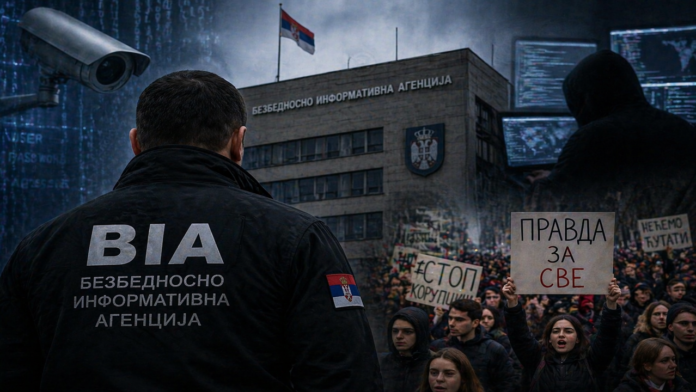
Serbia’s main civilian intelligence agency, the Security Information Agency (BIA), has long been at the center of public debate over its true role: safeguarding national security or serving as an instrument of political control.
Established in 2002 as a successor to earlier security structures, BIA operates under a legal mandate to gather intelligence, conduct counterintelligence operations and protect the constitutional order. However, critics argue that its real-world operations often diverge from these responsibilities.
According to analysts and former officials, concerns have persisted for years about the agency’s alleged involvement in political affairs. Some claim that intelligence structures in Serbia, including BIA, are more focused on maintaining the power of the ruling party than strictly adhering to their legal framework.
Lawyer Bozho Prellevic, a former interior minister following the fall of Slobodan Milosevic, has been among those voicing criticism. He argues that Serbia would not face its current political climate if the agency operated strictly within the law.
A similar view is shared by Predrag Petrovic of the Belgrade Centre for Security Policy, who says that for years the agency has primarily served to protect the ruling establishment and those close to it.
These concerns have intensified following mass anti-government protests that began in late 2024, reportedly led by students after a deadly incident at a railway station in Novi Sad that left 16 people dead. Protesters have accused authorities of a lack of transparency, particularly in relation to construction contracts linked to the tragedy.
Analysts suggest that BIA’s approach to these protests has raised further alarm. Petrovic claims the agency has treated student demonstrators as “internal enemies,” citing a state-linked video shown during BIA’s anniversary event in which the student movement was portrayed as a destabilizing force.
The video reportedly suggested that authorities, including President Aleksandar Vucic, had prevented what was described as a “colour revolution,” a term often used to characterize protest movements as externally influenced.
Beyond political concerns, surveillance practices have also drawn scrutiny. Observers say the agency possesses advanced digital monitoring capabilities, including tools to track mobile communications. There have also been claims, referenced by Amnesty International, of cooperation between Serbian and Russian security services, though details remain limited.
Legal safeguards are another point of contention. Critics argue that surveillance is not always conducted with proper judicial oversight, despite legal requirements. One recent case cited involved the arrest of two students based on intercepted communications, which their lawyers claim were obtained without a court order.
The agency’s authority to interact with citizens during protests has also raised questions. While it is not illegal for BIA officers to identify individuals, legal experts note that Serbia lacks clear limitations compared to many European countries, where such actions typically require specific grounds.
More broadly, analysts warn that the lack of effective oversight remains a key issue. Although BIA is formally accountable to the government and subject to institutional checks from parliament and oversight bodies, critics say these mechanisms have weakened in practice as Serbia has moved toward a more centralized political system.
Both legal experts and analysts stress that citizens are not legally obliged to respond to so-called “informal conversations” with the agency, even though such requests are often presented as voluntary.
However, the fact that individuals critical of the government are frequently invited to such meetings raises concerns about their true purpose. Some observers describe this as a potential misuse of security structures.
Ultimately, the debate over BIA reflects broader questions about democratic oversight, transparency and the balance between national security and civil liberties in Serbia.