
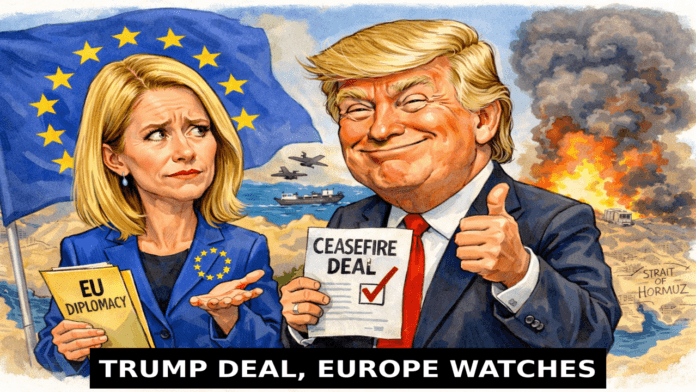
European leaders have cautiously welcomed a reported ceasefire agreement between the United States and Iran, describing it as a necessary pause in a rapidly escalating conflict that had raised fears of wider regional instability.
The deal, announced by Donald Trump, is said to include a two-week halt to hostilities and the reopening of the strategically vital Strait of Hormuz, a key artery for global energy shipments. According to statements from multiple officials, the agreement was reached following last-minute diplomatic efforts, reportedly involving mediation by Pakistan.
While details of the arrangement remain limited and have not been independently verified in full, European capitals responded with a mix of relief and caution, reflecting both the immediate benefits of de-escalation and lingering uncertainty over the agreement’s sustainability.
Ursula von der Leyen, President of the European Commission, described the ceasefire as “much-needed de-escalation,” signalling Brussels’ support for diplomatic efforts to prevent further escalation. She also stressed the importance of building on the truce to reach what she called an “enduring solution,” indicating that European officials see the agreement as only a first step rather than a definitive resolution.
A similar tone was echoed by Kaja Kallas, who noted that the ceasefire represented a step back from a potentially dangerous escalation. In a statement, she urged renewed efforts to stabilise maritime activity in the Gulf and to transform the temporary halt into a longer-term agreement.
In London, Keir Starmer described the development as “a moment of relief,” while confirming plans to travel to the Middle East to engage with regional partners. British officials are expected to prioritise ensuring the sustained reopening of the shipping corridor, which is critical for global oil supplies and economic stability.
Germany’s chancellor, Friedrich Merz, struck a pragmatic note, stating that the immediate objective should be a “lasting end to the war,” highlighting broader European concerns that the ceasefire could prove temporary without a structured political process behind it.
Beyond political leadership, the announcement also drew a response from Pope Leo, who welcomed the truce “with satisfaction and deep hope.” The pontiff reiterated calls for a return to negotiations, emphasising diplomacy as the only viable path to ending the conflict after days of increasingly aggressive rhetoric.
Not all reactions were unreservedly positive. Spain’s prime minister, Pedro Sánchez, acknowledged that ceasefires are inherently welcome but warned against overlooking the broader consequences of the conflict. He pointed to the destruction and loss of life already caused, suggesting that temporary relief should not overshadow accountability or the need for a just and lasting peace.
A similar blend of support and strategic caution came from Kyiv. Ukraine’s president, Volodymyr Zelenskyy, described the ceasefire as “the right decision,” noting its potential to save lives and open space for diplomacy. At the same time, he drew parallels with Ukraine’s own situation, reiterating that Kyiv continues to seek a ceasefire agreement with Russia, which has yet to materialise.
According to statements from Washington, the agreement is tied to Iran allowing safe passage through the Strait of Hormuz and engaging with a broader diplomatic framework reportedly proposed by Tehran. However, interpretations of the deal appear to differ between the two sides.
Iran’s foreign minister, Seyed Abbas Araghchi, indicated that Tehran would scale back what he described as “defensive operations,” while suggesting that any reopening of Hormuz would be conditional. These conditions reportedly include measures such as controlled access and a potential reduction in U.S. military presence in the region, pointing to a more cautious and conditional approach than that presented by Washington.
The divergence in narratives has raised questions among analysts about how firmly aligned both sides are on the terms of the agreement. Details remain unclear, and officials on both sides have yet to publish a comprehensive, jointly verified framework.
The ceasefire follows several days of mounting alarm across Europe. Senior officials had warned that continued escalation risked not only regional instability but also significant disruption to global energy markets.
Italy’s defence minister, Guido Crosetto, described the situation earlier in the week as dangerously unpredictable, while António Costa cautioned that attacks on civilian infrastructure could carry serious legal implications under international law.
Despite the diplomatic breakthrough, the episode has also exposed Europe’s limited influence over fast-moving security crises beyond its borders. While Pakistan is reported to have played a key mediating role, European governments were largely observers, even as the conflict posed direct risks to their economic and strategic interests.
The situation is expected to feature prominently in upcoming transatlantic discussions. Mark Rutte is due to travel to Washington, where the ceasefire and broader tensions are likely to test alliance unity at a time of already strained relations.
For now, European leaders appear aligned on one point: the ceasefire is necessary, but fragile. Whether it becomes the foundation for a longer-term settlement or simply a pause in a volatile confrontation remains uncertain.